
 EN
EN
Quick Links

The explosive growth of artificial intelligence workloads has fundamentally reshaped the design requirements of server power systems. As GPUs, CPUs, and dedicated AI accelerators (xPUs) pack ever more transistors into a single package, the on-board power delivered to these devices has climbed into the hundreds and even thousands of watts per socket. To keep pace, the voltage regulator modules (VRMs) and point-of-load (PoL) converters that feed these processors are being pushed toward higher current density and faster transient response than at any point in server history.
At the heart of every one of these power stages sits a deceptively simple component: the power inductor. Far from being a commodity part, the inductor has become one of the key enablers, if poorly selected, one of the key bottlenecks—of AI server power architecture. This article examines how AI server power delivery is evolving, what that evolution demands from inductors, the parameters engineers must weigh most carefully during selection, and how purpose-built inductor families such as CODACA's CSBA and CSHN series address these requirements in practice.
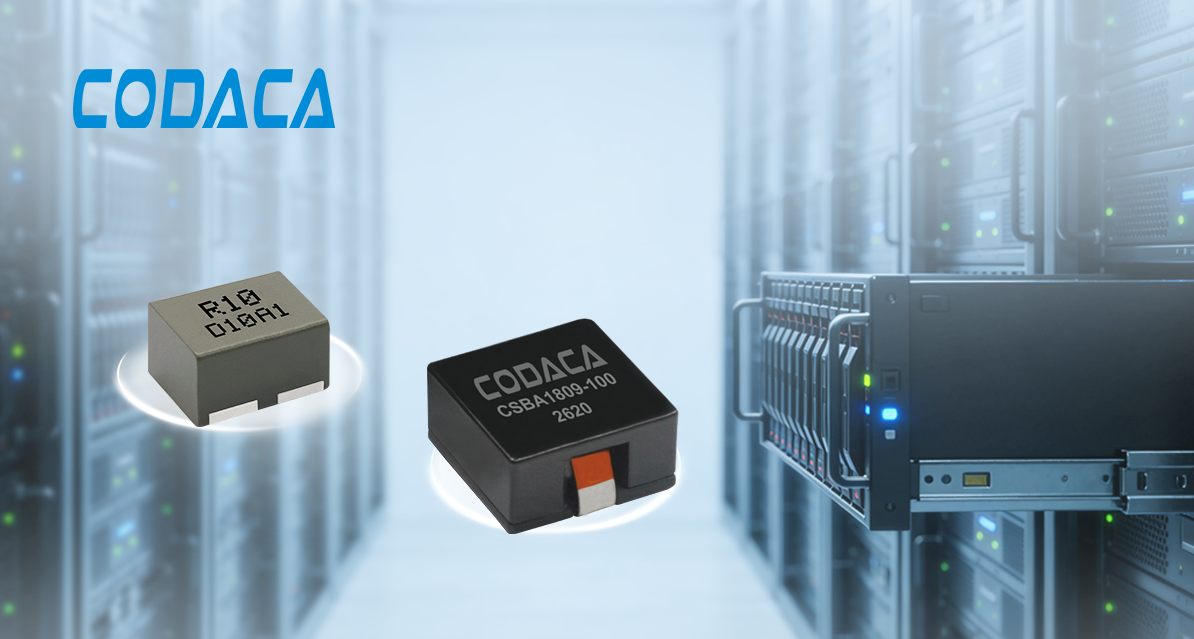
Traditional server power trains are giving way to architectures built around four parallel trends:
◾ High-voltage DC distribution. Many next-generation AI server racks are moving toward 48 V DC busbars in place of legacy 12 V distribution, reducing I²R losses across the backplane before power is stepped down at the board level.
◾ Distributed point-of-load conversion. Rather than a single centralized converter, power is now regulated close to each processor through multiple PoL stages, each with its own inductor bank.
◾ Digital control. Digital PWM controllers with fast feedback loops allow converters to respond to the extreme load steps characteristic of GPU workloads.
◾ Intelligent power management. Telemetry-driven power stages adjust phase count and switching behavior dynamically based on real-time load conditions.
Every structural change creates new performance requirements for inductors, making inductor selection a primary design decision rather than an afterthought. Why Inductors Matter in AI Server Power Delivery.
Power inductors sit at the front end of the chip-supply chain, delivering stable, low-noise current to the silicon that ultimately performs the AI computation. They serve several functions simultaneously across the AI server power path:
◾ Energy storage and voltage regulation in buck, multiphase, and TLVR converter topologies that feed GPUs, CPUs, and accelerator cards.
◾ Ripple smoothing so that fast-switching DC-DC stages deliver clean, stable output current rather than a noisy waveform that could destabilize sensitive digital logic.
◾ Signal filtering and noise suppression, where common-mode chokes and differential-mode inductors work alongside capacitors to strip high-frequency ripple out of the primary AC-DC stage and protect high-speed signal integrity.
Because inductors appear in nearly every power-conversion stage of an AI server—from the rack-level AC-DC front end down to the sub-1 V core rail of the processor—their electrical and thermal characteristics have an outsized influence on overall system efficiency, stability, and reliability.
Compared with inductors used in conventional servers, AI server inductors must satisfy a more demanding and interconnected set of requirements:
2.1 Low DC resistance (DCR) for high-current operation. The current draw of modern AI accelerators has increased sharply, and inductors must carry that current with minimal resistive loss. High DCR translates directly into higher I²R heating; if that heat is not effectively managed, the magnetic material can degrade or the inductor can fail outright, jeopardizing power-rail stability. Low-DCR construction is therefore treated as a baseline design parameter rather than a nice-to-have.
2.2 High-frequency operation with low core loss. AI server power supplies are commonly specified for conversion efficiencies approaching 99%. As switching frequencies climb to push more power through a smaller footprint, core and winding losses rise in tandem unless the magnetic material and coil geometry are specifically optimized for high-frequency operation.
2.3 Miniaturization without performance compromise. Board real estate inside an AI server is scarce, and power stages must be placed as close as possible to the processor to minimize parasitic inductance. This pushes inductor designers toward high-density magnetic materials and molded, one-piece construction that shrinks footprint and height while preserving current-handling capability—an important factor for high-density surface-mount placement.
◾ Sustained high reliability. AI servers run at high utilization essentially around the clock. Inductors in this environment must maintain stable electrical performance over extended operating life under continuous thermal and electrical stress.
◾ Strong EMI suppression. A magnetically shielded structure confines flux to the component itself, reducing radiated interference and helping the surrounding system meet electromagnetic compatibility requirements—an increasingly important consideration as board-level power density rises.
When narrowing down candidate inductors for AI server and high-performance computing boards, engineers typically converge on three headline electrical parameters—saturation current, DCR, and temperature-rise current—supported by a broader set of reliability and interference criteria.
GPU workloads are notorious for abrupt load transients; current slew rates (di/dt) during a load step can reach on the order of 100 A/µs. If the inductor's core saturates under such a transient, inductance collapses sharply, and the converter's control loop can lose regulation, threatening system stability. This makes headroom on saturation current—not just steady-state current rating—a critical selection criterion for AI server power stages.
DCR is the primary driver of copper loss and, by extension, overall converter efficiency. Because of this direct link to efficiency, engineers increasingly favor inductors built with flat-wire winding rather than conventional round-wire construction; flat-wire designs can reduce DCR by more than 30% compared to round-wire equivalents at a similar footprint, translating directly into lower power loss and cooler operation.
AI servers frequently run at high load 24/7, so thermal margin is not optional. Selection should ensure the inductor's rated temperature-rise current exceeds the circuit's maximum continuous operating current, with adequate design margin retained for worst-case ambient and airflow conditions.
VRM switching frequencies in AI servers have moved from roughly 300 kHz in legacy designs to the 1–3 MHz range and beyond. The immediate consequence is that the required inductance value—and therefore the physical size of the inductor—drops substantially. However, in the large-current, high-power-density environment typical of AI servers, higher switching frequency also increases both winding AC loss and core loss, so the higher frequency benefit must be paired with a magnetic material specifically engineered for low high-frequency loss.
Beyond these four headline parameters, engineers weigh magnetic shielding structure, long-term reliability data, and achievable power density within a constrained footprint as part of a comprehensive evaluation. In practice, the right inductor depends on matching the specific load profile, current magnitude, switching frequency, and thermal environment of each AI server power rail to a product engineered for that combination.
Different stages of the AI server power chain call for different inductor construction technologies:
◾ High-current power inductors are the workhorse of GPU, CPU, and accelerator-card power delivery, prioritizing strong saturation-current performance, sustained high-current handling with minimal temperature rise, favorable high-frequency loss characteristics, and low-loss magnetic materials such as ferrite or metal alloy powder.
◾ Molding power chokes fully integrate the coil and core through a compression-molding process using magnetic powder, which reduces flux leakage and improves saturation-current behavior. This construction typically yields higher power density and stronger EMI suppression than conventional wound inductors, making it well suited to high-power DC-DC converters and CPU/GPU power rails where board space is at a premium.
◾ TLVR (Trans-Inductor Voltage Regulator) inductors use a coupled dual-winding structure to simplify multiphase converter design and reduce component count on the PCB. For the low-voltage, high-current, fast-transient rails typical of AI accelerators, TLVR designs can improve transient response and reduce output ripple while lowering the required output capacitance—a meaningful system-level cost and space saving.
CODACA has built its inductor portfolio around exactly the requirements outlined above, developing proprietary magnetic alloy powder core materials and molded, one-piece manufacturing processes aimed at the large-current, high-saturation, high-frequency-low-loss, and small-footprint demands of AI servers and related intelligent computing equipment. Two series illustrate how these design principles translate into real components for AI power rails.
The CSBA series is built on CODACA's self-developed alloy powder magnetic core material and targets applications where board space and high-frequency efficiency are both at a premium:
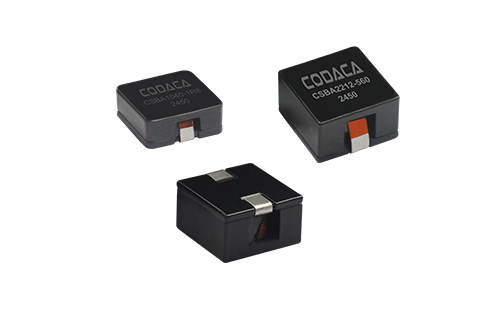
The CSBA series Proprietary alloy powder core with very low core loss, Soft-saturation current characteristic for stable performance under transient loads,Low loss at high frequency, suitable for GaN-based power solutions. The combination of low core loss and strong high-frequency performance makes the CSBA series a practical fit for DC-DC converters and switching regulators operating at the elevated frequencies typical of modern AI server VRM stages, including GaN-based power designs.
5.2 CSHN Series Molding Power Choke for AI Accelerators
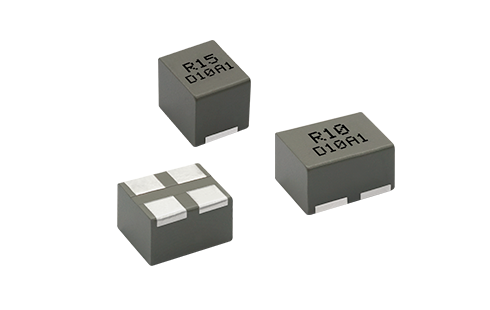
The CSHN series is a Molding Power Choke for the ultra-low-voltage, high-current rails found closest to AI processor dies. The CSHN series Inductance range is from 56 to 82 nH, As low as approximately 0.19 mΩ on representative parts. With its ultra-low inductance value, extremely low DCR, and high current-carrying capability in a compact molded footprint, the CSHN series is aimed squarely at the miniaturization and high-density mounting requirements of AI chip power modules, while its extended operating temperature range supports the sustained thermal loading typical of intelligent computing hardware.
5.3 Matching Inductor Selection to Application
For engineers designing AI server power rails, the practical takeaway is that inductor selection should start from the electrical and thermal profile of the specific rail rather than a generic "high-current inductor" search:
◾ In chassis or board locations where space is tightly constrained but current and frequency demands remain substantial, a compact high-current family such as the CSBA series is a strong candidate.
◾ For ultra-low-voltage, low-inductance, large-current rails feeding AI chips directly—where minimizing footprint and DCR is paramount—a molded chip inductor such as the CSHN series is better matched to the requirement.
◾ For multiphase, fast-transient GPU core rails, a TLVR-based inductor may offer system-level advantages in transient response and output capacitor count that a conventional single-winding inductor cannot match.
AI server power delivery has moved decisively toward higher voltage distribution, distributed point-of-load conversion, and multi-megahertz switching frequencies—all under continuous, high-utilization operating conditions. That combination places simultaneous demands on power inductors for low DCR, high saturation current, low high-frequency loss, compact size, strong EMI shielding, and long-term reliability.
Selecting the right inductor family, and the right model within that family, for each power rail is no longer a routine BOM decision but a meaningful lever for improving AI server power-conversion efficiency and overall system stability. Purpose-engineered product lines such as CODACA's CSBA and CSHN series—and the broader high-current, molded, and TLVR inductor technologies they represent—illustrate how magnetics suppliers are responding to these requirements as AI computing continues to scale.
For detailed electrical specifications, dimensional drawings, and sample requests, visit CODACA's official website:https://www.codaca.com.cn/.