
 EN
EN
Quick Links

High-end humanoid robots are typically equipped with more than 40 joint motors. The increase in motor count can easily trigger instantaneous current surges and intensified power consumption. Meanwhile, their power management systems are constrained by extremely compact installation space and complex internal electromagnetic environments. Balancing high current capability, low energy consumption, compact size, and strong anti-interference performance has become a critical challenge in product development and component selection across the industry.
The CODACA CSBA Series inductors deliver an efficient breakthrough with core advantages including high current capability, low loss, compact size, and magnetic shielding. They are ideally suited for high-power and space-constrained applications, significantly enhancing robot endurance and operational stability while providing comprehensive support for humanoid robot performance upgrades.
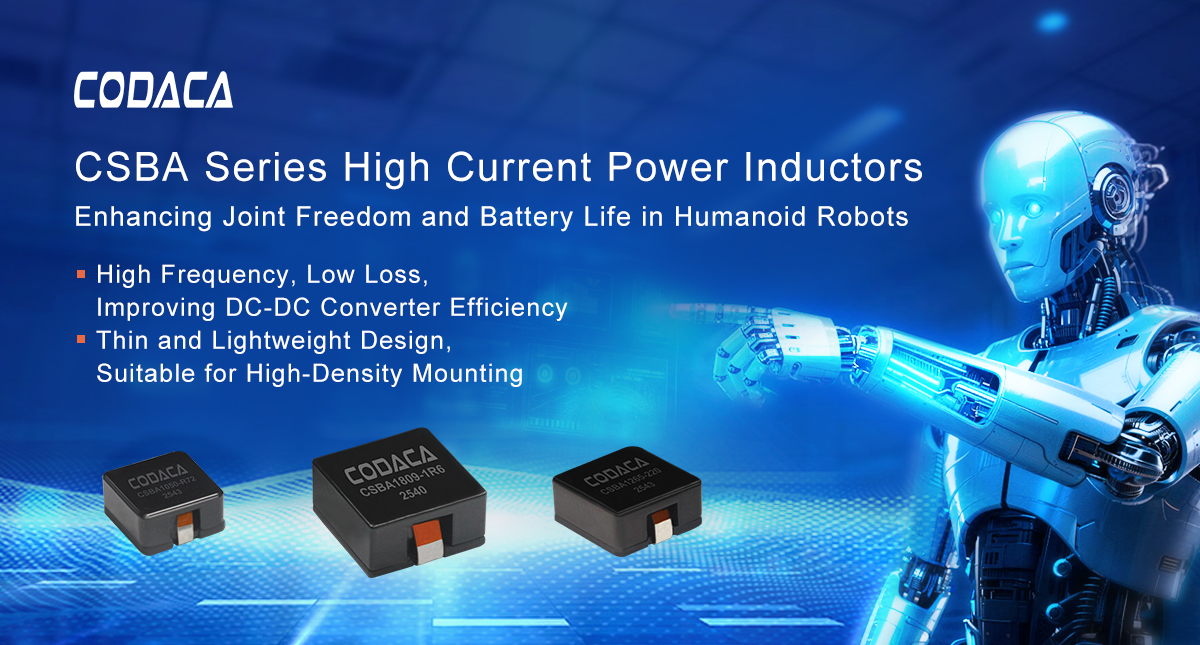
The CSBA high current power inductor series focuses on four core technological strengths: high current capability, low loss, compact structure, and magnetic shielding — comprehensively empowering improved endurance and stable operation.
With a slim and compact structural design, the series precisely fits into tight robotic installation spaces. It incorporates CODACA’s self-developed low-loss alloy magnetic powder core and flat-wire winding technology, optimized for high-frequency applications up to 500 kHz, enabling superior energy efficiency control.
With saturation current up to 70 A, the CSBA series confidently withstands peak current surges under dynamic load conditions. Its magnetic shielding structure effectively suppresses electromagnetic radiation, delivering strong EMI resistance suitable for complex electromagnetic environments inside robots.
Additionally, an ultra-low magnetostriction coefficient ensures low-noise operation, while soft saturation characteristics protect surrounding components. By combining reliability with high energy efficiency, the CSBA series significantly extends robotic battery life.
Humanoid robots are highly complex mechatronic systems integrating numerous high-energy-consuming core components. As fundamental components in power management and signal processing, inductors are widely applied in three essential systems: motor drive, power management, and sensing & control. Their performance directly determines operational stability, motion flexibility, and endurance limits.
High-end humanoid robots typically integrate 40–50 joint motors. Inductors provide efficient energy storage and current smoothing, ensuring smooth and precise rotation of each joint. This directly defines the upper limit of joint freedom and motion flexibility, guaranteeing fluid execution of complex movements.
As a core component of DC-DC converters, inductor loss directly impacts overall system power consumption and battery endurance. The CSBA series stabilizes and steps down the 48 V bus voltage to 12 V and below, precisely meeting the power requirements of AI processors, sensors, and other key components. While ensuring reliable power delivery, it minimizes conversion losses and enhances endurance performance.
Through optimized EMI design, inductors effectively prevent sensitive modules such as radar and cameras from internal electromagnetic interference. This safeguards sensing accuracy and control system stability, ensuring precise command response even under complex operating conditions.
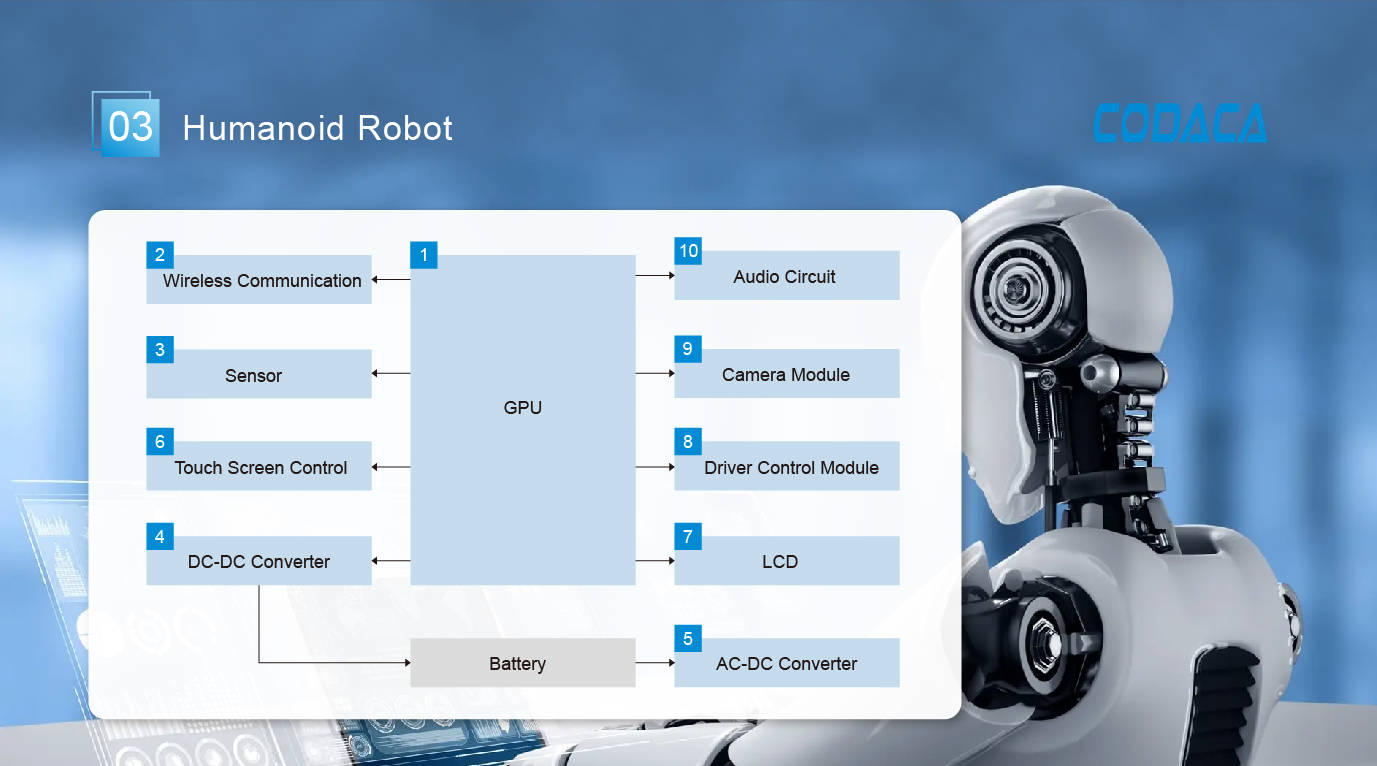
Main Applications of Inductors in Humanoid Robots
The unique operating characteristics and complex working environments of humanoid robots impose far more demanding requirements on inductors than conventional electronic equipment. The key selection challenges are concentrated in the following five dimensions, which directly determine the rationality of inductor selection and ultimately affect overall performance and long-term reliability.
1) High Saturation Current Capability
During dynamic load conditions such as start-up, running, and load-bearing operations, current can surge instantaneously. Inductors must maintain stable magnetic performance under high-current conditions to effectively prevent magnetic saturation–induced system failures, ensuring continuous and stable operation.
2) High-Frequency, Low-Loss Performance
Battery endurance is directly linked to user interaction experience, and component power consumption is a critical factor affecting runtime. Inductors must support high-frequency operation while achieving ultra-low energy loss, improving power conversion efficiency and minimizing wasted energy.
3) High Power Density Requirements
Internal robotic space is extremely compact, and power circuit boards require highly miniaturized designs. Inductors must therefore balance compact size and lightweight structure with strong high-current handling capability, achieving the optimal combination of “small size, high performance.”
4) Excellent Electromagnetic Compatibility (EMC)
Humanoid robots integrate high-speed digital circuits, motor drivers with strong switching noise, and sensitive sensors within the same system. Non-shielded inductors may cause magnetic flux leakage, interfering with sensor accuracy and control system stability. Reliable magnetic shielding is essential to ensure electromagnetic compatibility.
5) Strong Mechanical Stress Resistance
Frequent robotic movement generates significant mechanical vibration. Inductors must feature robust solder joints and stable internal structures with excellent resistance to vibration and shock, ensuring long-term reliability under complex mechanical stress conditions.
To address the core selection demands of humanoid robots — high current capability, low energy consumption, compact size, and strong anti-interference performance — CODACA introduces the CSBA high current power inductor series.
By deeply integrating four core advantages — high current capability, low loss, compact structure, and magnetic shielding — the CSBA series effectively resolves industry selection challenges. It is widely applicable in high-energy-consuming core systems such as DC-DC converters and motor drives, providing essential support for humanoid robot performance upgrades.
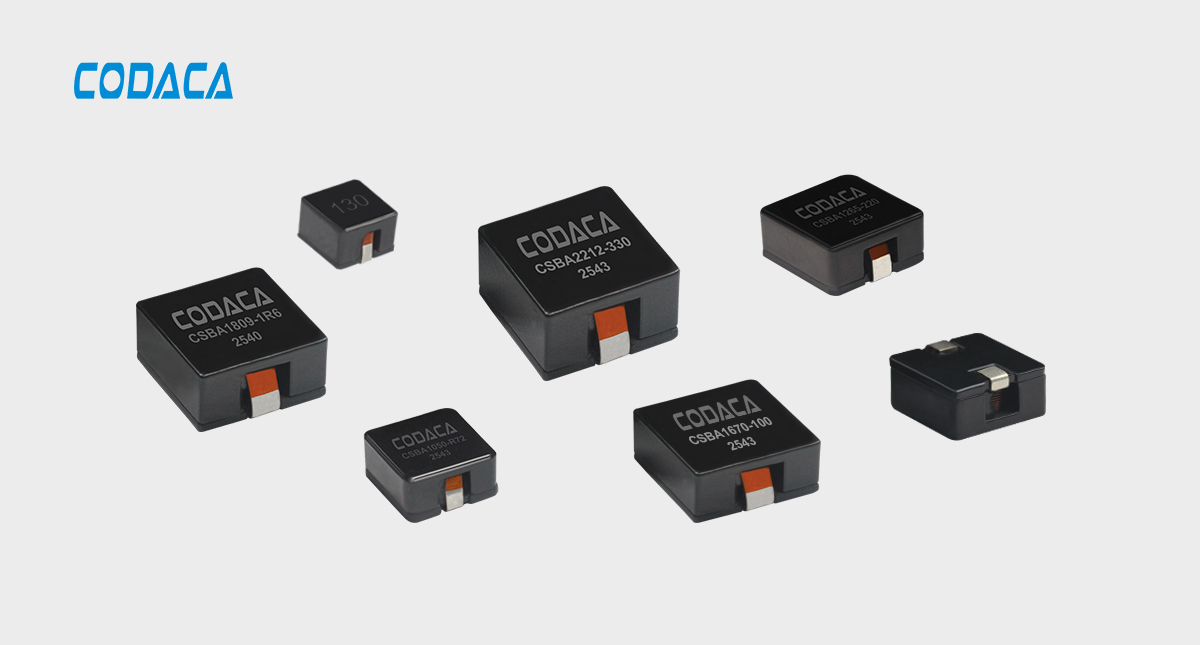
The CSBA series currently offers 13 models, with inductance values ranging from 0.13 μH to 100 μH. Its key parameters and fundamental performance characteristics are fully aligned with the application requirements of humanoid robots, enabling flexible selection across diverse scenarios.
Current Performance:
Saturation current ranges from 5.30 A to 70 A, with temperature rise current from 3.10 A to 50 A. The series can reliably withstand peak currents under dynamic load conditions, effectively preventing magnetic saturation and ensuring stable operation in high-current environments.
Structural Design:
Featuring a slim and compact structure, the CSBA series maximizes performance within limited packaging space. It flexibly supports the miniaturization needs of robotic power management systems while reserving sufficient layout space for other critical components.
Wide Temperature Adaptability:
Standard models operate within a temperature range of -55°C to +155°C, with selected models extending up to -55°C to +170°C. This ensures reliable performance under extreme operating conditions and delivers strong environmental adaptability.
High Reliability:
The CSBA series incorporates an optimized structural design, high-strength bonding processes, and reinforced solder joint construction, combined with vibration-resistant core materials. Having passed vibration testing above 5G, it maintains long-term stability even under the complex mechanical stress generated by frequent robotic movement.
Anti-Interference Capability:
With a fully magnetic shielded structure, the CSBA series provides outstanding EMI resistance and ensures strong electromagnetic compatibility in complex internal system environments.
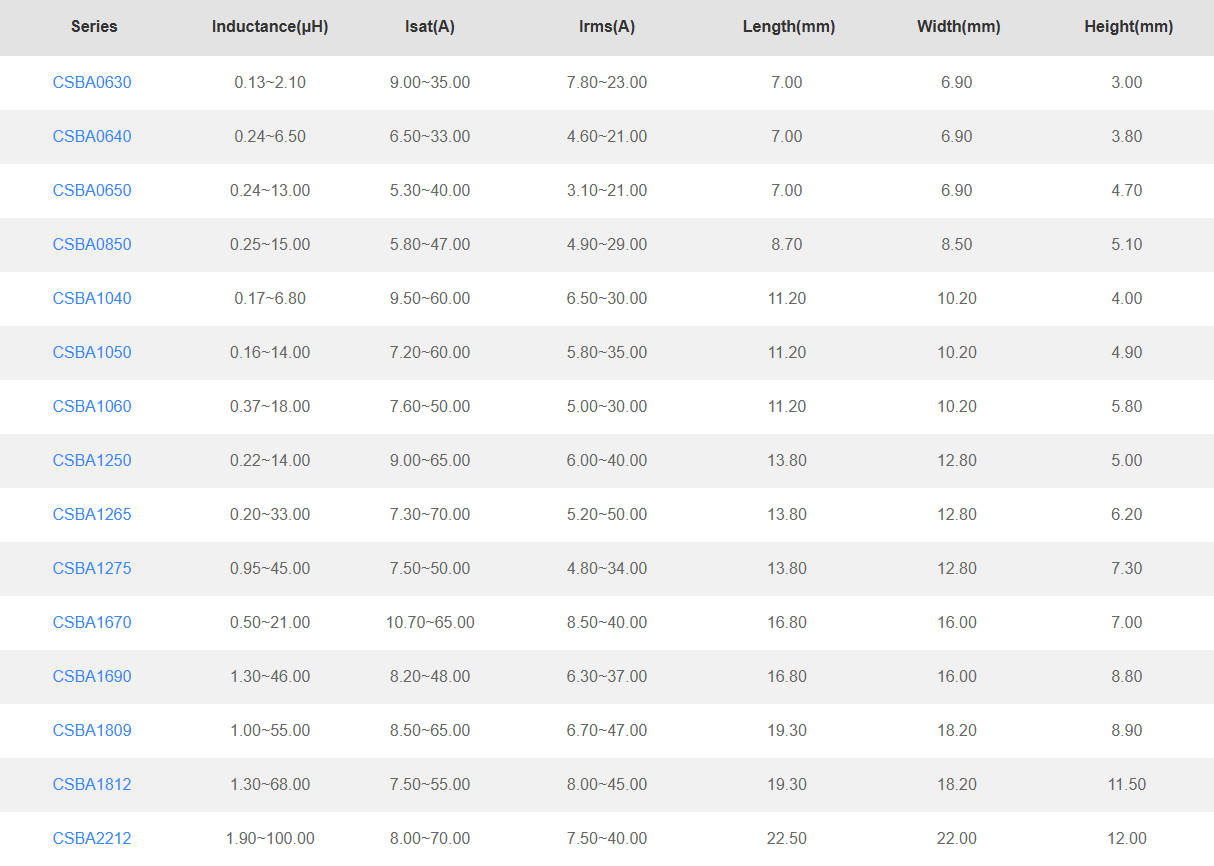
CSBA Series High Current Power Inductors – Key Models and Specifications
The core advantages of the CSBA series are reflected in the following five key dimensions, precisely matching the inductor selection requirements of humanoid robots and further enhancing human-machine interaction performance.
1) High Current Capability for High-Power Applications
The series adopts a flat-wire winding design, effectively reducing energy loss and temperature rise caused by the skin effect. It ensures long-term stable operation under high-current conditions and confidently withstands peak current surges generated by dynamic robotic loads. This makes it ideally suited for high-power applications such as motor drives, ensuring smooth and stable joint movement.
2) Ultra-Low Loss for Enhanced Endurance
Equipped with CODACA’s self-developed low-loss magnetic core materials and supported by precision manufacturing processes, the CSBA series strictly controls both core loss and copper loss at the source. Optimized for high-frequency applications up to 500 kHz, it delivers significantly lower losses than the industry average within the same package size. This greatly improves power conversion efficiency, minimizes energy waste, and effectively extends robotic operating time.
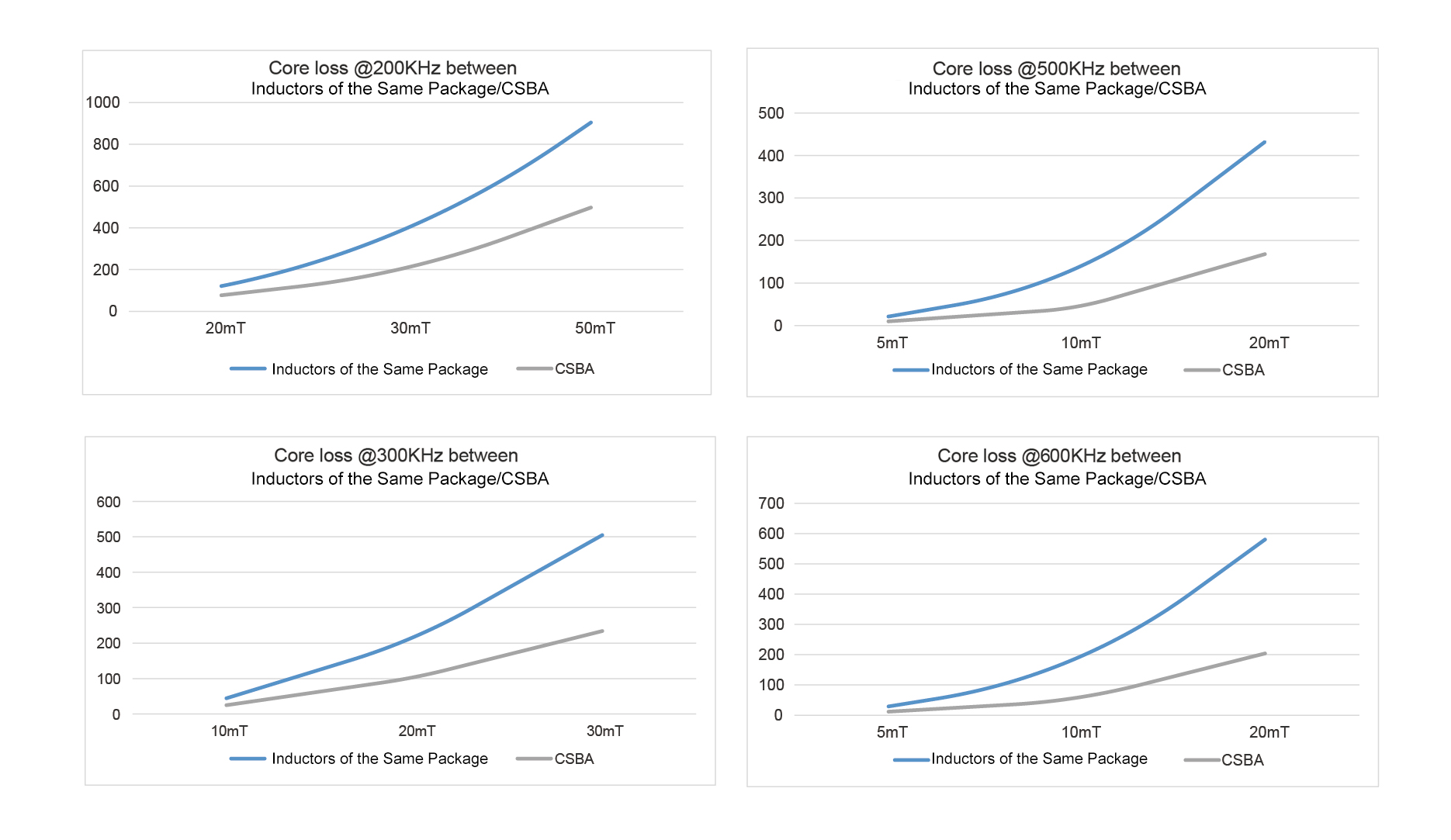
Loss Comparison Between the CSBA Series and Inductors of the Same Package Size at Different Frequencies
3) Compact Design for Space-Constrained Layouts
Featuring a slim and compact structural design, the CSBA series achieves the balance of “small size, high performance.” It perfectly meets the miniaturization requirements of robotic power management systems and can be flexibly integrated into limited installation spaces, reserving sufficient layout room for other critical components and supporting a more compact overall robot design.
4) Full-Scenario Anti-Interference for Stable Operation
Adopting a professional magnetic shielding structure, the series effectively suppresses electromagnetic radiation and significantly reduces interference to sensitive modules such as sensors and IC chips. With strong EMI resistance, it adapts to the complex electromagnetic environments inside robots and ensures comprehensive system stability.
5) Low-Noise Operation for Enhanced User Experience
Benefiting from an ultra-low magnetostriction coefficient, the inductors generate virtually no vibration noise during operation. They are suitable for noise-sensitive environments such as homes, offices, and public spaces, effectively enhancing human-robot interaction experience and expanding application scenarios.
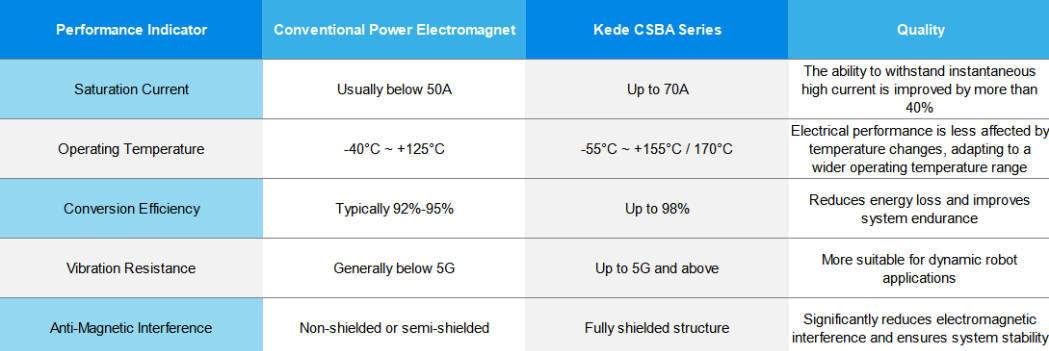
Performance differences between CSBA series and conventional inductors
5- Ecosystem Empowerment: CODACA Supporting the Scaled Development of Humanoid Robots
Humanoid robots are rapidly evolving toward higher performance, longer endurance, and more compact designs. Battery life, high-power drive capability, spatial adaptability, and anti-interference stability have become core competitive advantages, leading to increasingly stringent requirements for the comprehensive performance of electronic components. The CSBA high current power inductor series achieves key breakthroughs in power density, conversion efficiency, and operational reliability, fully adapting to the diverse application needs of humanoid robots. It serves as a critical foundation enabling the transition from laboratory development to large-scale mass production, supporting high-quality industry growth.
As a leading supplier of magnetic component technology, CODACA has specialized in inductor development for 25 years. In response to the inductor requirements of humanoid robots, CODACA has developed multiple categories and models, including high-current inductors, molding power choke, and SMD power inductors. Customized solutions are also available based on customer needs, enabling tailored optimization of dimensions and electrical characteristics.
For more details, please visit the CODACA official website or contact the sales team for consultation.