
 EN
EN
Quick Links

High Current Power Inductor, with their strong current handling capability, low DC resistance, and high conversion efficiency, have become core magnetic components for achieving efficient energy conversion and stable power delivery in industrial automation equipment.
Their applications span critical areas such as motion control, actuator drives, and power management. They play a vital role in ensuring efficient, stable, and safe system operation. Therefore, selecting high-performance and highly reliable high current power inductor is a key step in industrial design.

1- Core Applications of High Current Power Inductor in Industrial Automation
1.1 Servo Systems and Motor Drives
Servo drives are core components in industrial robots, CNC machining equipment, and automated production lines. The internal DC/DC converters and inverters rely on high current power inductor for efficient energy conversion and filtering. High current power inductor smooth current and reduce the impact of ripple current on motor control accuracy, while suppressing electromagnetic interference generated by switching devices.
In motor drivers, high current power inductor are used in current chopping circuits to stabilize winding current, improving motor torque output and positioning accuracy.
1.2 Industrial Power Equipment
Switching power supplies, UPS systems, and regulated DC power supplies in industrial automation systems all depend on high current power inductor.
In boost and buck topologies of switching power supplies, high current power inductor serve as energy storage components to achieve DC voltage conversion, meeting the requirements of industrial control equipment for high current and low ripple power.
In UPS systems, DC power is inverted into clean and stable sinusoidal AC power for the load. This process relies on rapid switching of power semiconductor devices, which generates significant high-frequency harmonic components. High current power inductor, working in conjunction with output capacitors, provide filtering to suppress these harmonics.
1.3 Industrial Robots and Motion Control Modules
Joint drives and end-effector control in industrial robots require high-density, high-current power modules. High current power inductor, with their compact size and high power density, are well suited to the limited internal space of robots.
In multi-axis motion controllers, inductors are used in the filtering circuits of each axis drive to reduce electromagnetic interference between axes and ensure coordinated motion accuracy.
1.4 New Energy Equipment and Charging Stations
New energy equipment in industrial automation — such as lithium battery manufacturing systems and photovoltaic module testing equipment — as well as industrial charging stations, require high current power inductor for efficient energy transmission and filtering.
For example, in lithium battery testing equipment, inductors play a key role in the charging circuit by providing filtering and energy storage, helping to achieve smooth, low-ripple charging current and improving cell consistency.
In industrial charging stations, high current power inductor are used in DC/DC conversion stages for energy storage and ripple suppression, meeting high-power fast-charging requirements.
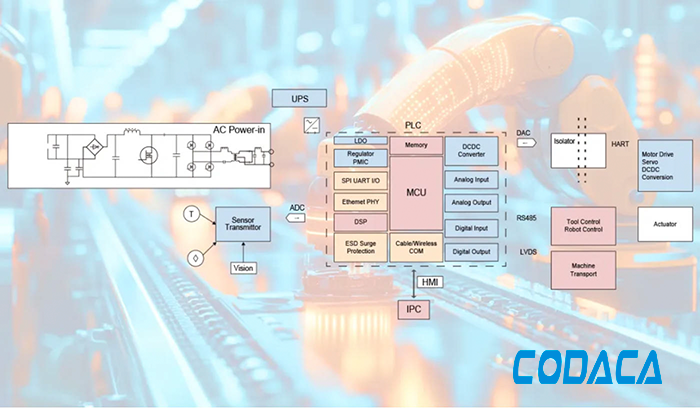
Industrial Automation Application Schematic
2- Requirements of Industrial Automation Equipment for High Current Power Inductor
Compared with other application scenarios, industrial automation equipment features high power, high energy consumption, and high-precision control. The requirements for power transmission, current stability, and electromagnetic compatibility are significantly higher than in most other fields. As a result, stricter demands are placed on inductors in terms of current carrying capability, power density, and compact size. The specific requirements are as follows:
2.1 Stable Power Supply for High-Power Components
In industrial automation systems, servo motors, inverter-driven fans and pumps, and robotic joint modules require instantaneous high current during startup and heavy-load operation to meet torque and speed demands.
Conventional inductors may not withstand such surge currents, leading to magnetic core saturation and a sharp drop in inductance. This can cause uncontrolled ripple current, voltage fluctuations, equipment vibration, shutdown, or even component damage.
High current power inductor, utilizing flat-wire windings and high-saturation-flux-density core designs, can stably handle hundreds of amperes, ensuring continuous and reliable operation of high-power equipment.
2.2 Meeting Efficiency and Thermal Requirements of High Power Density Equipment
Industrial automation equipment is evolving toward miniaturization, modularization, and integration — such as compact servo drives, integrated motion controllers, and small industrial robots. Limited internal space requires power circuits to deliver high output power within compact volumes, demanding higher power density from inductors.
High current power inductor feature low DC resistance (DCR) design to reduce conduction losses and heat generation, thereby improving power conversion efficiency. Meanwhile, magnetic shielding structures minimize electromagnetic radiation and interference with nearby precision circuits, making them suitable for integrated system environments.
2.3 Ensuring Stability and Accuracy of Precision Control
Industrial automation requires extremely high control accuracy. For example, CNC machining equipment may require micron-level positioning accuracy, while industrial robots may achieve repeatability as precise as 0.01 mm.
Such precision depends on stable current signals. Excessive current ripple can cause motor speed fluctuations and sensor data drift, directly affecting production quality. High current power inductor, with strong ripple suppression capability, ensure stable and continuous current output from drive circuits, forming the foundation of high-precision motion control.
The characteristics of “high power, high density, and high precision” in industrial automation determine the necessity of high current power inductor to handle heavy loads, stabilize circuits, suppress interference, and ensure efficient and reliable production line operation.
3- CODACA High-Current Power Inductor Solutions
CODACA has been deeply engaged in the inductor industry for 25 years, with in-house capabilities in magnetic core development and flat-wire winding design.
To meet the needs of industrial automation, the company has developed more than 50 series of high current power inductor, including CPEX、CPRX、 CPEA、 CSQX、 CSQA、CSBX、CSCM、CSCFand CSBA. Applications cover traditional industry, automotive electronics, artificial intelligence, and emerging fields such as low-altitude aviation.
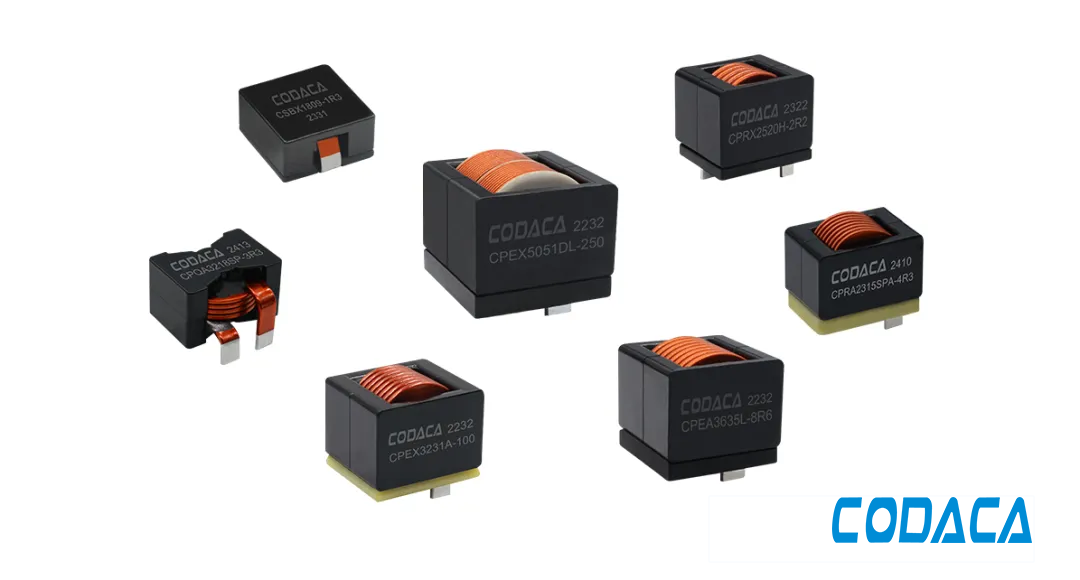
CODACA high current power inductor feature:
◼ High Current Carrying Capability
Flat-wire winding design effectively reduces skin effect, achieving low temperature rise and high efficiency, enabling long-term stable operation under high-current conditions.
◼ Excellent Soft Saturation Characteristics
Advanced magnetic core materials provide superior saturation performance, with saturation current up to 422A, meeting compact and high power density design requirements.
◼ Low Loss and High Efficiency
By combining flat-wire windings with self-developed low-loss magnetic powder core materials, overall losses are minimized, with power conversion efficiency reaching up to 98.89%.
◼ Strong Electromagnetic Interference Resistance
Magnetic shielding structures effectively reduce electromagnetic radiation, ensuring compatibility in harsh industrial environments.
◼ High Reliability
With a CNAS-accredited laboratory, CODACA independently conducts reliability testing. Some products have passed AEC-Q200 automotive-grade reliability certification.
Industrial-grade inductors operate within a temperature range of –55°C to +155°C and withstand vibration shocks above 5G, ensuring long service life and stable performance in demanding environments.
◼ Flexible Customization
Customized solutions are available to meet specific customer requirements in size, electrical characteristics, and application scenarios.
High current power inductor are foundational components enabling industrial automation to advance toward higher power, greater integration, and smarter systems. CODACA high current power inductor are widely used in industrial power supplies, motor drives, new energy storage, charging stations, data centers, DC-DC converters, industrial robots, LED drivers, and UAVs.
Their compact structural design, excellent electrical performance, and high reliability help reduce PCB space and component count, improve overall system efficiency, optimize circuit design, and enhance performance — supporting innovation and intelligent upgrading in industrial automation.